
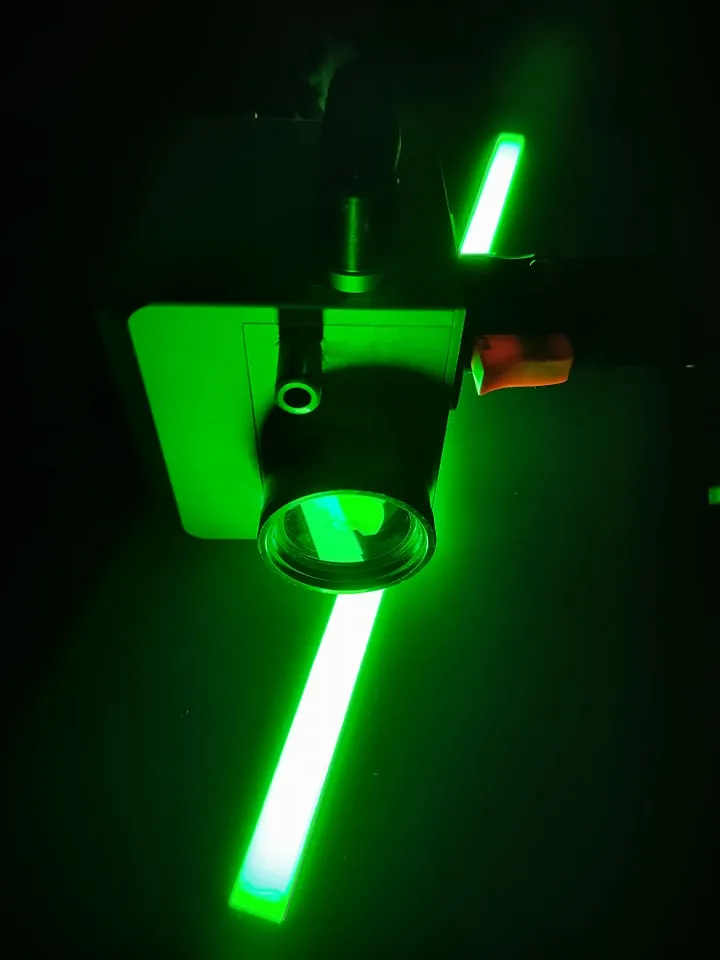
Laser cleaning is an innovative method that uses precisely targeted laser energy to clean surfaces and remove impurities such as dirt, rust, paint, or other deposits. It is based on sending laser pulses onto the surface, where they remove the impurities without damaging the substrate material itself.
The equipment used in laser cleaning emits laser beams that are absorbed by the impurities on the surface. This energy causes the material to vaporize or detach in micro-layers. The process is extremely precise, as the lasers can be adjusted according to different materials and surfaces.
Eco-friendliness – No chemical detergents or water are needed, and it leaves behind no waste.
Contact-free – The laser beam does not touch the surface, so no mechanical wear and tear occurs.
Precision and safety – Laser cleaning can be adjusted to remove only the desired layers (such as rust or dirt) without damaging the original surface.
Versatility – Can be used on many different materials, such as metals, stone, glass, and plastic.
In industry: For cleaning rust, oil, and other deposits from machinery and metal parts.
In restoration: For cleaning historical monuments and artifacts, as the method does not damage delicate surfaces.
In the automotive industry: For removing rust and paint from car parts and bodies.
In construction and maintenance: For keeping buildings, bridges, and other infrastructure clean.
Laser cleaning is an efficient and durable solution for many cleaning and restoration needs.
Metals:
- Steel, aluminum, copper, stainless steel, titanium, etc.
Rust, oil, paint, and other impurities can be removed from metal surfaces.
Plastics:
- PVC, ABS, polyethylene, polypropylene, polystyrene, etc.
Laser cleaning can remove paint, glues, and other impurities..
Note! Plastics are highly challenging materials for lasers. We are constantly testing different types of plastics.
Stone and ceramics:
- Concrete, natural stone, granite, marble, limestone, porcelain, etc.
We can use the laser to remove graffiti, paint, mold, and other impurities.
Wood:
- We can use the laser to remove paint, varnish, discoloration, glue, soot, and other impurities..
Note! For example, the complete removal of graffiti from a painted or coated surface can be impossible in certain cases if the paints have absorbed or dissolved into one another.
The laser will not damage the original material when used correctly!
– Our 1000W pulse laser (MOPA) requires a 220V (16A) power supply.
– Our 3000W CW laser requires a 380V (32A) power supply.
We do not require any other resources. If necessary, we can use our own generators at the customer's location for an additional fee if mains power is not available.
- There is no direct answer to this question. The cleaning speed depends heavily on the object and material being cleaned. Different materials and impurities require different amounts of time.
- It is good to note that different materials may require different parameters and settings for successful laser cleaning. The cleaning results also depend on the material and the condition of the surface.
- We have not yet found any disadvantages to laser cleaning.
- Laser cleaning is a fast, efficient, and eco-friendly alternative to older cleaning methods.
- A CW (Continuous Wave) laser emits a continuous beam of laser light, whereas a pulse laser emits laser light in short, bursts or pulses.
- CW lasers are typically used on targets that require high power, while pulse lasers are used on targets that require high precision and accuracy.
- Eco-friendly
- Mobility
- Fast schedules
- Flexibility
- Efficient equipment
- Professional, cheerful, and trained staff
- A continuous desire to improve
To us, a satisfied customer is what matters most!
BT Laser Oy – A reliable partner for projects of all sizes.


